However, there is a new world record that we all have a part in. this past Sunday (August 26th 2012) the extent of ice in the arctic sea fell to its lowest level since satellite data began being accrued in 1979. Not only did the daily satellite record show that the melt had reached a new record it had literally blown the 2007 record “out of the water” (sorry about that, but I could not help myself). The ice extent (that area of ocean with at least 15% ice) was over 27,000 square miles (70,000 square kilometers) lower than the lowest 2007 extent.
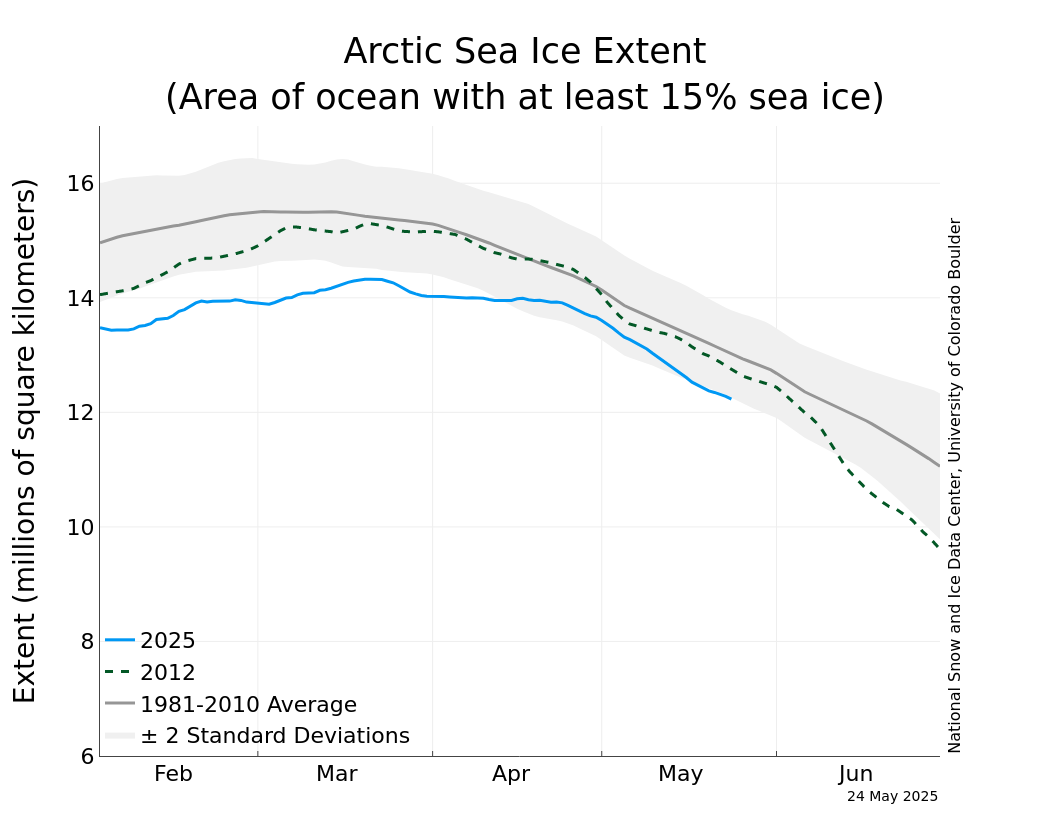
That is a lot of missing ice. That amount of ice could cover Massachusetts, Connecticut, New Hampshire, and a good chunk of Vermont. That is the amount of ice beyond the 2007 record that melted in a single day. There are still two to three weeks of melt season left, and with each day's satellite data we should expect a new world record to be set.
"The previous record, set in 2007, occurred because of near perfect summer weather for melting ice. Apart from one big storm in early August, weather patterns this year were unremarkable. The ice is so thin and weak now, it doesn't matter how the winds blow." -- Mark Serreze NSIDC Director
What will the final world record for this year be? We will not know officially until the first week of October, but I expect it to be impressive. Will it be enough ice to cover the entire eastern seaboard? How about Europe; will we lose enough arctic sea ice to have completely covered Europe (10,000,000 square kilometers)? Of course it cannot do that because there are only about 4,000,000 square kilometers left. In other words we are within striking distance of an ice-free arctic sea.
In the US we are approaching a historic election. Global climate change is one of several divisive issues that polarize potential voters into one of two camps. On the one hand are those voters who take the overwhelming scientific consensus (that global climate change is causally linked to greenhouse gas emissions by human activity) at face value. On the other hand there are those folks who think that there is either no GCC or that there are better explanations than human activity for it. The former camp tends to be Democrat, and the later Republican.
"Greenhouse gasses are the only consistent explanation for a persistently warming Arctic," -- Ted Scambos senior NSIDC researcher
There are other good divisive issues. The United States Electorate apparently has many good reasons to be polarized. People cannot even agree about what the best reason to disagree is.
Next year the arctic ice will probably not melt to the extent that it will this year. I make this prediction on the basis of a statistical phenomenon known as regression to the mean. In any sample set a deviant data point (like a world record) will likely be followed by a point that is closer to the mean of the population. However, the mean arctic ice coverage is decreasing over time so we will have lower world records in the not-too-distant future. The only thing that will stop this stuttering streak of progressively lower world records will be a completely ice-free arctic summer.


No comments:
Post a Comment